
Why did we go into nationwide lockdown when we were adding 100 cases a day and why are we not going into lockdown but allowing cricket stadiums, political rallies and Kumbh Melas when we are adding 40,000 cases a day? asks Aakar Patel.

Based on a feedback, the exchange could cap a sector's weight at 25 per cent, or align with the broader market.

'A balanced head plus heart approach would be a full opening up of the economy including manufacturing and internal travel in the country but excluding COVID-19 hotspots,' recommends Jaimini Bhagwati.
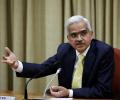
The Reserve Bank remains laser-focused to bring back retail inflation to 4 per cent over a period of time in a non-disruptive manner, Governor Shaktikanta Das stressed while voting for status quo in interest rates, as per minutes of the October policy meeting released on Friday. The central bank has been mandated by the government to ensure the Consumer Price Index (CPI) based inflation is at 4 per cent, with a band of 2 per cent on either side. The retail inflation, which was above 6 per cent during May and June, has started moving down and stood at 4.35 per cent in September.

'The most important thing is that the psychological signal it is giving to the markets and international markets,' says former finance secretary Arvind Mayaram.

Despite the relaxation of the one-child policy in 2016, the number of live births per 1,000 people fell to a record low of 10.48 in 2019, down from 10.94 in 2018.

'Although Hong Kong weathered many a storm and displayed a remarkable resilience to bounce back, the developments in the territory have raised question marks with regard to its future stability and prosperity.' A revealing excerpt from Rup Narayan Das's Hong Kong Conundrum: Pangs of Transition.

India said its economy grew 7.3 percent in the October-December quarter.

'With the June quarter GDP shrinking by nearly a quarter, there is an even greater economic imperative: Reduction of uncertainty,' observes Neelkanth Mishra.

'They want (the ownership and management of PSU banks) to pass into the hands of a private sector entity.' 'Ownership of these banks will go from the public sector to private sector.'

'Several businesses like entertainment, hospitality, travel etc would never be the same again.'

The IS curve is a measure of the sensitivity between GDP and prevailing interest rates.

Finance Minister Nirmala Sitharaman on Monday said the government has begun an exercise to assess the impact of the pandemic on the economy and likely contraction in GDP, even as she did not rule out the possibility of another stimulus to boost growth.

India is currently under the 21-day lockdown since March 25, with only essential services exempted to contain the fast-spreading virus.

Welcomes measures include a road map for fiscal consolidation of 3% of GDP by fiscal 2016-17, GST roadmap by the end of the year.

India will have to devise policies to ensure overall growth in FY16.

At the pre-Budget meeting at Niti Aayog, Modi called for a focussed effort from all stakeholders in order to achieve the target of $5 trillion economy. The participants urged the government to focus on credit expansion, exports growth, governance of PSBs, increasing consumption and job creation.

The minutes of the December MPC meet reveal members felt the current spike in the headline inflation rate was due to a temporary supply shock on the food front, expected to moderate by the second quarter of 2020-21.

These include increasing the public float in listed companies to 35 per cent from 25 per cent, increasing the minimum statutory limit for FPI investment in a firm from 24 per cent to the sectoral foreign investment, and lowering government holding in listed public sector undertakings.

'This is a period of significant uncertainty, of unknown unknowns.'
India needs to work on economic parameters to outpace China.

The higher salaries and pension outgo will be equivalent to about one per cent of the GDP.

India's human development indicators show that deprivation extends well beyond the 22 per cent of population who live below the official poverty line.

Petrol price can go down to Rs 75 a litre across the country if brought under the ambit of the Goods and Services Tax (GST), but there is a lack of political will, which is keeping Indian oil product prices at one of the highest in the world, economists at SBI said on Thursday.

Many in the US establishment must hope that the crisis would put the brakes on China's growing military might. Well, it ain't gonna happen, says T T Ram Mohan, who was appointed a member of the prime minister's economic advisory council on Wednesday, October 28, 2021.

Several critics including some rating agencies have doubted prospects of meeting this ambitious fiscal deficit target.

'There is a misconception that gold is a dead asset in India.' 'Around 30 per cent of agriculture loans are collateralised by gold, Soumya Kanti Ghosh and Saket Hishikar, economists at the SBI, point out.

Top gainers include Yes Bank, HUL, Vedanta, NTPC, Bharti Airtel, Adani Ports, PowerGrid and Tata Motors, rising up to 5 per cent.

It was 55.3 per cent for the same period last year, and data shows the fiscal deficit for April-May was kept in reasonable check in spite of heavy frontloading of expenditure.

'The answer for a quicker boost to growth is simple -- run a much larger deficit, use the resulting public resources to ensure adequate price support for agriculture, subsidise wage costs of MSMEs and accelerate public sector construction-intensive activities,' advises Nitin Desai.
.jpg)
The country has enough forex reserves to meet the demand.
Gold purchases have risen after the Reserve Bank of India (RBI) and the government lifted the restrictions imposed on imports in 2013.

Revising up inflation bands for the central bank will hurt the poor, former deputy governor of RBI Viral Acharya said on Wednesday, terming the current 4 per cent midpoint on price-rise as a "reasonable target".

'During the lockdown if you terminate your employee, then you will face action under the NDMA.' 'This will be the first time something like this will happen in the history of India.'

Defence experts want defence expenditure to be at 3% of GDP, which they consider minimum to counter the two-front threat from China and Pakistan, internal insurgencies, and dominating a 7,500 km coastline and the Indian Ocean beyond. What Arun Jaitley has given India this Budget is 2.16% of GDP, observes Ajai Shukla.

The actual expenditure will only be marginally higher and hence, the multiplier effect will be muted.

So, what's the problem if our present is screwed up when the future promises to be profitable? It's an Indian habit, notes Shyam G Menon.

This is the fifth straight cut in rates by the Reserve Bank of India in as much policy reviews in 2019, and takes the total quantum of reductions to 1.35 per cent.

After tabling the Survey, Jaitley told reporters that fiscal deficit for the current year will be 4.5 per cent which needs to go down further in the next two years.
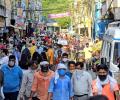
Like on Pegasus, like Covid, there have been no answers from the government about why the situation on the economy and India's future is where it is today, notes Aakar Patel.
 © 2026 Rediff.com - Advertise with us - Disclaimer - Privacy Policy - Sitemap - Feedback - About us - Terms of use - Grievances